
German Schools abroad Society


CAPTURED
AND
REMEMBERED
A Collection of Family
Memories from the Global German School Network
Curated by Lily Li
Edited by Lily Li, Rose Li
Website designed by Lily Li
Kuratiert: Lily Li
Redaktion: Lily Li, Rose Li
Webdesign: Lily Li
FOREWoRD
The German Schools Abroad Society (GSAS) is thrilled to present Captured and Remembered: A Collection of Family Memories from the Global German School Network, an exhibition displaying the histories of students and teachers from 13 German schools abroad across 11 nations and 5 continents. GSAS believes the cultural preservation of these memories—fragile due to their age and time—is essential for facilitating intercultural communication between these vastly diverse schools, as well as deepening our bottom-up understanding of history. For each student, teacher, and school, gaining new, fresh, and often surprising insights into other peers' histories is a transformative experience that constructs a shared identity of global heritage.
Historical milestones—such as the fall of the Berlin Wall and China's Cultural Revolution, among many others—are frequently interpreted from a top-down, macro-scale perspective. While useful for understanding the broader tide of history, this approach overlooks the thousands of individual human narratives and tiny acts of courage/empathy that construct and humanize history. Thus, through curating micro-scale memories, this exhibition aims to challenge this top-down perspective. For each family photo or micro-narrative submitted, it places them against images of monumental historical events, aiming to contextualise these memories and highlight their significance. The exhibition showcases a total of 22 distinct historical events and corresponding memories, along with a total of 100 photos, covering 155 years of history (1871–2026). Such are the goals of GSAS's exhibition.
-- Lily Li, Founder of GSAS
Student at German Swiss Int. School, Hong Kong
"This is a genuinely compelling project, one that reflects a sophisticated understanding of historiographical debates that many students rarely engage with so directly. Its emphasis on "bottom-up" micro-historical experience and narrative echoes the work of scholars like Carlo Ginzburg and the microhistory tradition, who have long argued that grand historical events only become fully legible when grounded in lived experience. The framing of family memory as a site of "cultural preservation" is especially astute, given how quickly such fragile, unrecorded histories are lost between generations. To translate these ideas into a living, cross-cultural archive is a cherished effort, and one that speaks to both intellectual maturity and genuine care for the histories being preserved."
-- Li Ji, Associate Professor of History
The University of Hong Kong
This is a visual exploration of the exhibition's mission, featuring a few words from the founder.

Memories from the late 1800s

The Deutsche Internationale Schule den Haag, 170 years after its founding in 1856.
DISDH official website.

Gravenstaat, viewed from the Buitenhof, The Hague, 1880.
Historical archive image, via Jacqueline Alders.

Proclamation of the German Empire at Versailles, 1871.
Anton von Werner. Reproduced via The Guardian.
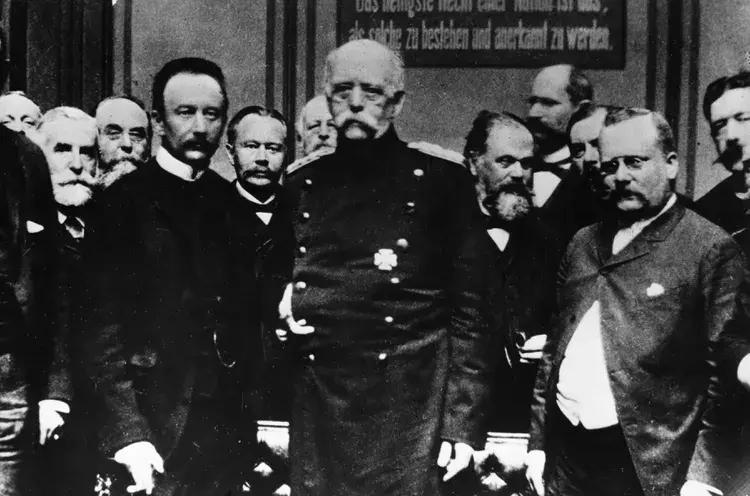
Otto von Bismarck, the first chancellor of Germany (1871-1890).
Hulton Archive, via ThoughtCo.
1871-1883: The Rise of the German Empire
Spotlight: German International School the Hague (DISDH)
The German International School The Hague started as a humble church school in 1856 when Germany was still split into smaller, independent states. However, a major turning point occurred in 1883 when the institution officially expanded to launch its general school curriculum. This took place during the rise of the German Empire, following the historic 1871 unification of Germany. Under the leadership of Otto von Bismarck, the newly unified German nation-state began rapidly forming a single national identity and projecting its cultural and economic influence across Europe. The expansion of the school in 1883 from a localised religious class into a formal, structured educational institution reflected this broader historical background, allowing the German population in the Netherlands to align their children's education with the newly unified homeland.

The original building of the Deutsche Internationale Schule Pretoria.
DSP official website.

Celebration of the Kaiser’s birthday by the German school community in Pretoria, January 27, 1902.
DSP official website.

Students and faculty of DSP, May 1901.
DSP official website.

Pastor Grünberger (left) and Friedrich Klinkenberg-Müller (right), contributors to DSP's founding.
Hulton Archive, via ThoughtCo.

German volunteers during the Second Boer War, 1899.
Historical archive image, via German Colonial Uniforms.
1899-1902: The Anglo-Boer War
Spotlight: German International School Pretoria (DSP)
The first photo was provided by a student attending the German International School Pretoria (DSP), which was founded by German immigrant communities during the Second Boer War. Many such immigrants joined the Boer republics as foreign volunteers fighting against the British Empire, and others came seeking similar opportunities. After the war ended in 1902 with the signing of a peace treaty—the Treaty of Vereengiging, the South African province of Transvaal became a British colony. With the hopes of preserving their culture, native language, and German identity in an English dominated environment, many immigrant families decided to establish a German school, which started off with 43 students. The fourth photo portrays Grünberger and Klinkenberg-Müller, both of whom greatly contributed to DSP's founding.
Memories from the mid-1900s

Family portrait of a GSIS student’s paternal grandfather and siblings, 1956-57.
Private family collection, via a GSIS student contributor.

A struggle session during the Heilongjiang Land Reform, 1946.
Historical archive image, via Aboluowang.

Celebrations marking the completion of the Heilongjiang Land Reform.
Lin Hui, via Aboluowang.

Agricultural collectivisation and forced labor during the Great Leap Forward, 1958.
Jennifer Llewellyn and Glenn Kucha, via Alpha History.
1946-62: Land Reform and the Great Leap Forward
Spotlight: German Swiss International School Hong Kong (GSIS)
The family of a GSIS student underwent significant hardships during the Heilongjiang Land Reform in 1946. As the Chinese Communist Party experimented with land reform strategies in Northeastern China, the student's great-grandfather, a landowner, fled Heilongjiang with his son, choosing to leave his wife and daughter behind. As a result, the two women suffered from brutal beatings during struggle sessions at the hands of local peasants, but fortunately survived in the end. The Heilongjiang Land Reform was a precursor to larger-scale movements throughout Maoist China (e.g. the Great Leap Forward). Similarly, the first photo showcases a rare, heartwarming moment of another GSIS student’s family approximately two years before the Great Famine struck, another failed campaign part of the Great Leap Forward that aimed to collectivise agriculture in China.
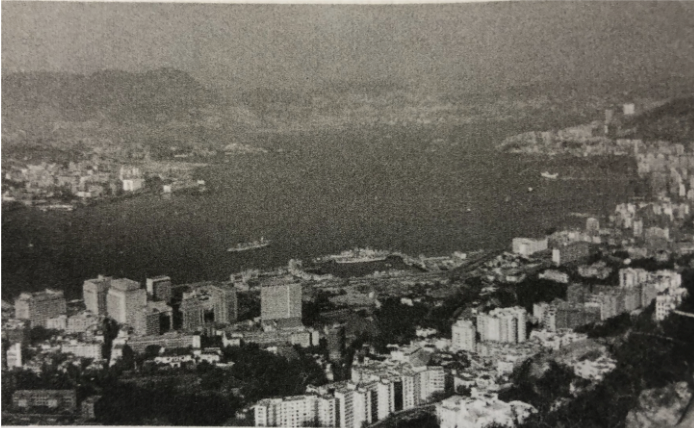
The Hong Kong Harbour, taken from the Peak, 1964.
Private family collection, via Mr. Marcus Walker, teacher of Physics at GSIS.

Night view of Mong Kok neon light streets, 1960s.
David Bellis, via Gwulo.

Red trams in Nathan Road, Kowloon.
David Bellis, via Gwulo.

Widespread use of automobiles in Hong Kong, 1960s.
David Bellis, via Gwulo.

Growing textile and garment factories in Hong Kong.
Historical archive image, via Hong Kong Memory.
1960s: Hong Kong’s Golden Age of Industrialisation
Spotlight: German Swiss International School Hong Kong (GSIS)
The first photo was contributed by a GSIS teacher, Mr. Marcus Walker, whose father was dispatched to Hong Kong as part of the British military during the 1960s. His service coincided with the city’s golden age of industrialisation, where Hong Kong evolved into a global industrial center and powerhouse. The images document this modernisation through the rise of the textile and garment industries, which became the backbone of the economy and drove significant increases in employment and exports. The expansion of the city's infrastructure is also evident in the increased use of private automobiles, the growth of public transportation, and the expansion of Victoria Harbour. These represent a rapidly growing city that combined local culture with British- and Chinese-driven modernisation.

British soldiers in Sarawak, taken from Kuala Bakam, 1964.
Private family collection, via a GSIS teacher contributor.

Wikipedia.
British soldier winched up by a helicopter in Borneo, 1964.

Enlistment of ethnic Sarawakians and Sabahans into Malaysian military activities.
Wikipedia.

British naval troops during the Brunei Revolt, 1962.
Historical archive image, via HistoryMaps.

Soldiers in a river near Bekenu, Brunei, December 1962.
National Army Museum.
1963-1966: The Indonesia-Malaysia Confrontation
Spotlight: German Swiss International School Hong Kong (GSIS)
The first photo was provided by a teacher at GSIS who had older generations sent to Sarawak in 1964 at the height of the Indonesia-Malaysia confrontation, a war waged by Indonesia to oppose the formation of the Federation of Malaysia. The famous Brunei Revolt of 1962, as depicted in the fourth picture, was an attempt to oppose the monarchy’s proposed inclusion into Malaysia and thus acted as a catalyst of the confrontation. The third photo shows indigenous Sarawakians and Sabahans enlisting in Malaysian military operations, representing local ethnic groups that opposed Indonesian forces and supported the British cause. As Malaysia was supported militarily by Western powers and Indonesia enjoyed indirect support from China and the Soviet Union, the Indonesia-Malaysia confrontation represented a proxy war of the broader Cold War waged in Asia.

A view of Little Aden from Jebel Taalla, 1964.
Private family collection, via Mr. Marcus Walker, teacher of Physics at GSIS.

Stan Meagher, Hulton Archive and Getty Images, via Flashbak.
A child and members of the National Liberation Front, 1967.

Use of tear gas by British soldiers to silence the protests.
Wikipedia.

Arrival of British troops via helicopter, 1964.
National Army Museum.
1963-1967: The Aden Emergency
Spotlight: German Swiss International School Hong Kong (GSIS)
The first photo was taken by a Mr. Marcus Walker, a GSIS teacher whose father was dispatched to the Aden Colony in South Yemen during the period of British decolonization. The decolonization process began with an armed rebellion led by the National Liberation Front in October 1963, and was fought between British forces and nationalist insurgent groups who sought to end decades of colonial rule through guerrilla warfare and mountain uprisings. The photos further depict British soldiers using tear gas to suppress civil unrest, as well as troops deploying from helicopters into the rugged terrain near Jebel Taalla. Child soldiers were drafted into the insurgency against British rule, a conflict which led to twenty years of decolonization—this teacher’s father being one of the witnesses in this process.

A convoy led by a Saladin, 1966.
Private family collection, via a GSIS teacher contributor.
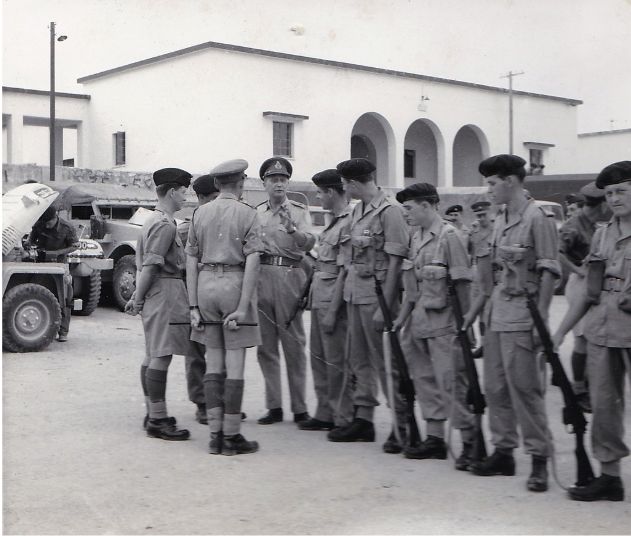
Formation of British soldiers during the withdrawal from Libya.
LibyaUpdate.

The British garrison retreat in the Western Desert campaign, December 1940.
John Diamond, via Warfare History Network.

The British Army in the deserts of Libya, April 1963.
Historical archive image, via Imperial War Museum.

Speech by Muammar Gaddafi after the overthrow of the Libyan monarchy, 1969.
Gamma-Keystone and Getty Images, via TIME.
1966-70: British withdrawal from Libya
Spotlight: German Swiss International School Hong Kong (GSIS)
The first photo was contributed by a GSIS teacher whose family members witnessed the withdrawal of British forces from Libya. The event was catalyzed by the rise of Libyan Prime Minister Muammar Gaddafi, who overthrew King Idris in 1969 and demanded the removal of foreign military bases. During this transition, which took place within the Cold War, the United Kingdom sought to manage its evacuation while strategically protecting Libyan oil reserves from falling under the influence of Soviet-aligned communist interests. The fifth photo showcases Gaddafi proudly addressing a crowd of supporters after overthrowing the Libyan monarchy, leading to a process of British retreat that eventually ended on March 31, 1970, a date commemorated by the Libyans as Evacuation Day.

iDSP’s new school building, 1970, after a relocation from temporary quarters in Rocquencourt.
iDSP official website.

Wikimedia, via Curtis Cate, The Atlantic.
Charles de Gaulle, president of France from 1959-1969.

De Gaulle’s 1966 announcement of the French withdrawal from NATO.
HistoryCentral.

Charles de Gaulle and John F. Kennedy, Paris, 1961.
Wikimedia.
1966: French Withdrawal from NATO
Spotlight: German International School Paris (iDSP)
As shown in the first photo, iDSP’s history traces back to the French withdrawal from NATO in 1966, which was officially announced by President Charles de Gaulle on March 31 as tensions increased between the Western allies during the middle years of the Cold War. While a new building for the German International School Paris was being erected on rue Pasteur, the school moved to Rocquencourt for two years in 1968. As Rocquencourt was the original headquarters for NATO, the French withdrawal created space in Rocquencourt for the school to use as temporary quarters. The NATO headquarters, on the other hand, were relocated from Paris to Brussels, the capital of Belgium. The final photo depicts United States president John F. Kennedy along with de Gaulle after their talks at Elysee Palace in Paris, showcasing US-France relations at the time.

Family photo of an American family with their adopted Vietnamese son.
Private family collection, via Mr. Daniel Santella, teacher of History at GSIS.

The Detroit News Collection and Wayne State University, via Michigan in the World.
Anti-war protests at the University of Michigan, 1969.

Evacuation of Vietnamese children under Operation Babylift, April 1975.
Frederick Burkle, via Al Jazeera.

Operation Babylift and the relocation of Vietnamese children to the West.
Robert Stinnett, the Oakland Museum of California, via ABC News.
1965-1973: The Vietnam War
Spotlight: German Swiss International School Hong Kong (GSIS)
The first photo was contributed by Mr. Daniel Santella, whose family, being anti-war supporters during the Vietnam War, adopted his Vietnamese brother in 1975. They brought him up in Boston and introduced him to American society. The historical operation that made this adoption possible was President Gerald Ford’s famous Operation Babylift in April 1975, which brought in approximately 3000 South Vietnamese infants for adoption in the US, Canada, Australia, and Europe. Growing up with a Vietnamese brother had a formative impact on this teacher, who saw how people’s choices can make a positive impact on others. As children, they spent ages playing catch out, soccer, and baseball in the street, seeing who could make the most acrobatic catches or throw the ball high enough to clear the top of the towering oaks lining Lowell Street. These memories formed an important part of his childhood.

Collapse of the Banqiao Dam in Henan, China, in the early mornings of August 5, 1975.
Covell Meyskens, via Everyday Life in Mao’s China.

Justin Higginbottom, via MCLC Resource Center.
Widespread flood, famine, and disease in the aftermath of the Banqiao Dam collapse.

Red guards in support of the CCP, 1966.
Universal History Archive and Getty Images, via The Guardian.

Military parade in front of Tiananmen Square, 1966.
Ding Li and Mo Yu, via Voice of America Chinese.
1966-76: China’s Cultural Revolution
Spotlight: German Swiss International School Hong Kong (GSIS)
As direct victims of the Henan Banqiao Dam failure in 1975, a GSIS student’s two aunts were visiting their uncle’s home in Zhumadian, Henan when the flood broke out and the Banqiao Dam collapsed. The following days involved desperate acts of survival, such as living on treetops and chewing on tree bark, until the student’s grandfather fortunately rescued them on a boat. A few special and moving stories have survived within the family since then, such as the student’s grandmother, who was the head nurse at a local hospital, taking in hundreds of survivors for treatment while not sleeping for days on end. This flood represents the broader failures of the Cultural Revolution, where the CCP built infrastructure with the aim of speed—to fulfill ideological goals—rather than quality and safety. Consequently, this directly led to breakdowns in infrastructure, along with famines, floods, droughts, and disease across the whole of China, contributing to the growing death toll at the time.
Memories from the late-1900s

GESS’ first day of school at Jalan Kampong Chantek with 6 students, 1971.
GESS official website.

West Germany’s socioeconomic boom, known as “Wirtschaftswunder,” or the Miracle on the Rhine.
Ulrike Bosse, via Norddeutscher Rundfunk (NDR).

The Volkswagen Beetle, a symbol of post-war recovery in West Germany.
Wikipedia.

Lee Kuan Yew, the first prime minister of Singapore since 1959.
Michael Stroud and Getty Images, via TIME.

A newspaper article reporting Singapore’s independence, 7 August 1965.
Historical archive image, via Singapore Rebel.

German camera company Rollei’s technicians in Singapore.
Historical archive image, via Singapore Economic Development Board.
1971: West Berlin’s Economic Miracle & Singapore’s Industrialisation
Spotlight: German European School Singapore (GESS)
As shown in the first photo, GESS was founded on August 25, 1971, by a small group of expatriate German parents with just six students. This event was a direct consequence of German engineers, diplomats, and businessmen flooding into a rapidly growing post-colonial Singapore, which achieved its independence in 1965 after separating from Malaysia. Under Prime Minister Lee Kuan Yew, Singapore rapidly industrialized itself to become a global financial centre. This made the country highly attractive for West German corporations like Siemens, Bosch, and Lufthansa, who flourished under West Germany’s post-WWII economic boom (known as “Wirtschaftswunder,” depicted in the second and third photos) and began aggressively expanding into Southeast Asia. For example, as shown in the final image, German camera company Rollei sent a portion of its employees to Singapore.

The inconclusive stalemate of the Korean War, 1950-53.
Wikipedia.

The demilitarized zone (DMZ) between North and South Korea, a period of tension and conflict.
Lily Rothman and Liz Ronk, via TIME.

The Berlin Wall between East and West Germany.
Norbert Enker, LAIF/Redux, via National Geographic.

A 1980 beer factory, a symbol of rapid economic development in South Korea.
Lee Heesoo, via Maeil Business.
1976: Cold War Division in Korea
Spotlight: German School Seoul International (DSSI)
The German School Seoul International was founded in 1976, when the Korean peninsula remained a high-stakes, tense area due to the ongoing standoff from the Korean War (shown in the first photo) that divided the peninsula into two. For the German families and founders of the school, their experiences in their homeland of West Germany (where the Berlin Wall was located) mirrored their new lives in South Korea, reflecting the same Cold War-era trauma, division, and political tension of their homeland. Furthermore, by the mid-1970s, South Korea was in the middle of its legendary economic transformation, known as the “Miracle on the Han River,” as shown in the fourth photo. This gradually transitioned South Korea from a war-torn country into a global, industrial powerhouse, and the founders of the school were the engineers sent from Germany to collaborate on this economic miracle.
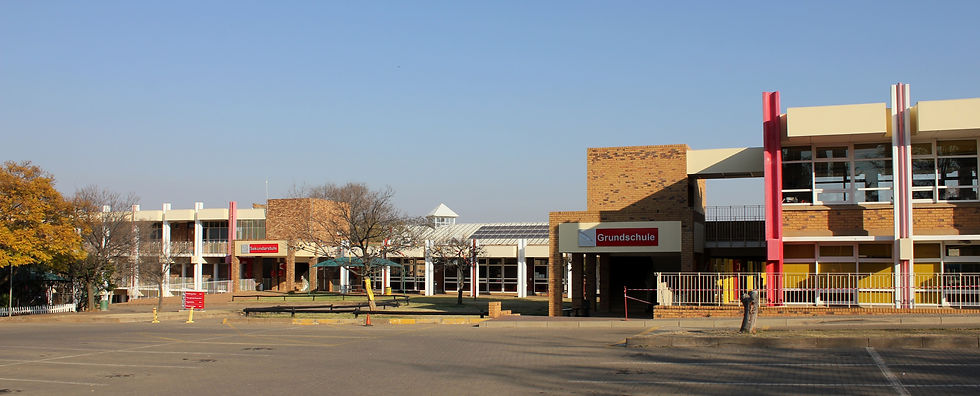
The 1977 opening of the Deutsche Höhere Privatschule Windhoek to children of all ethnic groups.
Wikipedia.

Wikipedia.
The building of the Turnhalle Constitutional Conference, a political assembly in Windhoek.

An anti-Apartheid rally in South West Africa, April 1985.
Paul Mattsson, via Anti-Apartheid Movement archives.
British naval troops during the Brunei Revolt, 1962.
Historical archive image, via HistoryMaps.
Soldiers in a river near Bekenu, Brunei, December 1962.
National Army Museum.
1977: Legal Desegregation of Urban Areas in South
West Africa
Spotlight: German Private High School Windhoek (DHPS)
As depicted in the first photo, the annual general meeting of the Deutsche Höhere Privatschule Windhoek made a decision in 1977 to officially open its doors to children of all ethnic groups at the beginning of the 1978 academic year. This decision took place during a broader cultural change in the South African administration of Namibia (then South West Africa). By 1978, the Turnhalle Constitutional Conference and international pressure were forcing the colonial government to begin dismantling certain aspects of the Apartheid (the country’s system of racial segregation), leading to a relaxation of strict segregation laws. This eventually paved the way for the repeal of laws like the Immorality Act, which banned romantic relationships between people of different races. The school’s proactiveness in welcoming students of various ethnicities thus reflected its mission of inclusivity and diversity.

A teacher and his family at Checkpoint Charlie in the late 1970s.
Private family collection, via a GSIS teacher contributor.

Private family collection, via a GSIS teacher contributor.
West Berlin guards at the Berlin Wall.

Prosperous West Berlin in the 1970s.
Private family collection, via a GSIS teacher contributor.

British military training in West Berlin.
Private family collection, via a GSIS teacher contributor.

A 16-hour face-off between armed US and Soviet tanks at Checkpoint Charlie, October 1961.
BBC.
1978-1980: Checkpoint Charlie, the Berlin Wall
Spotlight: German Swiss International School Hong Kong (GSIS)
The first four photos were provided by a German teacher at GSIS whose family visited the iconic Checkpoint Charlie in West Berlin during the late 1970s. Among these, the second image depicts West German guards on high alert at the Berlin Wall, which calls to mind the notorious 1961 tank standoff as part of the Second Berlin Crisis. That 16-hour tense confrontation, which saw armed American and Soviet tanks positioned just 100 meters apart, represented the height of the Cold War and the nearing threat and fear of nuclear escalation. This memory is further personalized by a 1980 photograph of the teacher’s father, captured during his military training while stationed on a British tank.

The earliest school building of the Deutsche Schule Kuala Lumpur, site of its first school day, January 1979.
DSKL official website.

Oil shocks of the 1970s.
Alex Beasley, via Yale University.

The Iranian Revolution of 1979.
AP and Special to People’s World, via People’s World.
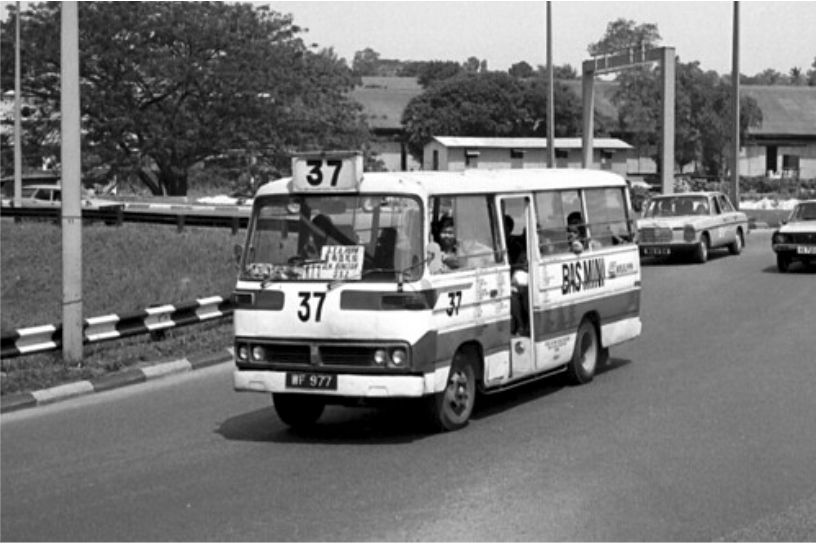
Kuala Lumpur, the capital of Malaysia, a rapidly industrializing and resource-rich country in the late 1970s.
Ian N. Lynas, via Flickr.
1979: 1979 Oil Crisis
Spotlight: German School Kuala Lumpur (DSKL)
The German School Kuala Lumpur opened its doors in 1979 with three students on its founding day, as seen in the first photo. It was founded by German families who immigrated to Malaysia due to massive global changes at the time, including a severe, global oil crisis which was a result of the Iranian Revolution. Because the global oil production dropped sharply and fuel prices skyrocketed, Western nations, including West Germany, had to aggressively diversify their trade networks and look for stable, manufacturing-heavy partnerships outside of traditional Western spheres. Malaysia, as a resource-rich and rapidly industrializing nation, became an attractive focal point for German manufacturers. Consequently, the school was established to educate the children of these German expats stationed abroad.

A teacher's family on a 1980s shopping trip in the Kowloon City Market, Hong Kong.
Private family collection, via a GSIS teacher contributor.

A Hong Kong family shelling shrimps in the Kowloon City Market.
Private family collection, via a GSIS teacher contributor.

Roasted Cantonese ducks in the Kowloon City Market.
Private family collection, via a GSIS teacher contributor.

A Cathay Pacific airplane flying over Kowloon.
Private family collection, via a GSIS teacher contributor.

A Hong Kong-style fishing boat in the waters of Kowloon.
Private family collection, via a GSIS teacher contributor.

Construction on a sunny day in Kowloon.
Private family collection, via a GSIS teacher contributor.

The Far East Finance Centre, a 1982 Hong Kong landmark.
Wong & Ouyang (HK) LTD.
1980s: Hong Kong’s Economic Boom
Spotlight: German Swiss International School Hong Kong (GSIS)
The first six photos were taken by a GSIS teacher’s family when they visited Kowloon, Hong Kong for shopping in the 1980s. The 1980s represented a period of huge financial and economic boom with the opening and reform of China’s economic system. The establishment of Special Economic Zones (SEZ) such as Shenzhen and Zhuhai allowed many Hong Kong manufacturers to seek cheaper means of production and labor. Most factories were moved to Shenzhen and Hong Kong itself became a global financial center under British rule. Most significantly, built in 1982, the Far East Finance Center became the financial hub of Hong Kong during the 1980s, and it continues to be an iconic piece of architecture today. The 1980s further saw the golden age of Hong Kong culture with a variety of new Cantonese songs, movies, and TV shows like the iconic “Legend of the Condor Heroes,” produced in 1983.

The official commencement of the German International School Sydney, 1989.
GISS official website.

Fall of the Berlin Wall, 1989, leading to the reunification of Germany.
Tracy Wilkinson and Erik Kirschbaum, via Los Angeles Times.

US president Ronald Reagan’s “Tear Down This Wall” speech, a demand for the removal of the Berlin Wall by Soviet leader Mikhail Gorbachev, June 1987.
Mike Sargent, via CBS News.

The rapid modernization of the Sydney skyline surrounding Darling Harbor, 1985.
Robert Pearce, via Commercial Real Estate.
1989: Fall of the Berlin Wall
Spotlight: German International School Sydney (GISS)
The German International School Sydney (originally named the German School Johannes Gutenberg) began operating in February 1989, starting in the Sydney suburb of Prospect with just 28 students from Kindergarten to Year 4, as shown in the first photo. Globally, 1989 was a hugely significant year that impacted the geopolitical Cold War landscape, involving the fall of the Berlin Wall in November. This event signalled the collapse of the Iron Curtain (the boundary that divided Eastern and Western Europe), the fast-approaching reunification of Germany, and the end of the decades-long Cold War division. As a new era of global connection swept across Europe, the German populace in Australia had a similar vision. The school was founded to provide a multicultural education that combined Australian and German teaching traditions, which reflected the open and interconnected world that was emerging on the global stage in 1989.

A GSIS student’s maternal family with a rare summer treat on a hot day.
Private family collection, via a GSIS student contributor.

GSIS teacher Ms. Lin’s visit to the Giant Wild Goose Pagoda with her father, Xi’an, 1992.
Private family collection, via Ms. Jing Lin, teacher of Chinese at GSIS.

Deng Xiaoping, leader of China from 1978 to 1999.
Wikipedia.

Deng Xiaoping and US president Jimmy Carter at the Sino-American signing ceremony, 1979.
Carter White House Photographs Collection and Yang Hengjun, via The Diplomat.
1980-2000: Reform and Opening-Up in China
Spotlight: German Swiss International School Hong Kong (GSIS)
The first photo was contributed by a GSIS student, which showcases her mother and sisters enjoying a summer retreat with their grandmother in a period when free time and money were hard to come by; the second photo depicts a GSIS teacher, Ms. Jing Lin, and her father when they visited the Wild Goose Pagoda in faraway Xi’an, a journey out of reach under Mao’s previous leadership. These cherished moments and peaceful times captured in the photos were made possible by a period of reform and opening-up in China. Deng Xiaoping’s four modernizations—specifically agriculture, industry, science, and national defense—pushed China’s economy into a post-Mao era, characterized by economic prosperity, which presented commoners with new opportunities. Diplomatic negotiations made with US president Jimmy Carter, as shown in the fourth image, further raised China’s standing on an international scale.
Memories from the early-2000s

A GSIS Hong Kong student's visit to the German International School Boston.
Private photo album, via a GSIS student contributor.

The GISB school building at 57 Holton Street, Boston.
Private photo album, via a GSIS student contributor.

The Human Genome Project, 1990-2003.
Olympia Valla/Getty, Nurk et al., Katie Martin and Sarah Zhang, via The Atlantic.

The Human Genome Project, depicted in the Buffalo News Sunday paper, 1997.
Ashley Smart, via Undark.

Boston, home to 1,000+ biotechnology companies, including Moderna, Biogen and Takeda.
Bio.News Staff, via Bio.News.
2001: The Human Genome Project
Spotlight: German International School Boston (GISB)
The German International School Boston was founded in 2001 with just 17 kindergarten and elementary students. The school’s founding coincided with a highly significant era of scientific modernization. Specifically, 2001 sees the publication of the first draft of the Human Genome Project, an international research effort to map the DNA base pairs in the human genome. This project was heavily centered in Boston's elite academic institutions like MIT and Harvard. Throughout the early 2000s, this breakthrough triggered a boom in biotechnology and life sciences, transforming the Boston area into a world-renowned scientific hub. This booming industry attracted a wave of international researchers, geneticists, and medical specialists, including many from Germany. The school was established by a dedicated group of parents to provide a high-quality, bilingual education for the children of these global academics and professionals.

A GISNY student, Marina, baking cookies (Plätzchen) during Christmas,
early 2010s.
Private family collection, via Marina Speckesser, a GISNY student contributor.

TES students Adrian and Felix decorating an advent wreath (Adventskranz) during Christmas.
Private family collection, via Adrian Wiese and Felix Hoffmann, two TES student contributors.

The traditional German advent wreath (Adventskranz).
Laura Boston-Thek, via Schliersee Magazin.

TES students Adrian and Felix celebrating family birthdays with gifts and cake (Kuchen).
Private family collection, via Adrian Wiese and Felix Hoffmann, two TES student contributors.
Growing textile and garment factories in Hong Kong.
Historical archive image, via Hong Kong Memory.
2010s: Emigration Wave from Germany
Spotlight: German International School New York (GISNY), Taipei European School - German Section (TES)
The first photo shows Marina, a German student in New York, participating in a family tradition—baking cookies (Plätzchen)—around Christmas time, something the family maintained in the early 2000s. Similarly, Adrian and Felix, German students who moved to Taipei (second photo) celebrated their German heritage by decorating Advent wreaths (Adventskranz) during Christmas, a deeply rooted German tradition. Germany being the birthplace of the Advent wreath, this tradition reminds them of home despite their physical residence in Taiwan. During birthday celebrations of loved ones, Adrian and Felix further participated in cake (Kuchen) baking while singing “Happy Birthday” in English, German, and Chinese, embracing their multicultural identity (fourth image). As part of the broader historical background, the 2010s represented a steady emigration wave from Germany, where around 150,000 to 180,000 Germans emigrated each year. Seeking better career opportunities and lower tax burdens elsewhere, these German emigrants maintained peaceful family traditions despite being on foreign soil, signalling a longing for home and embracing of new cultures.

Founding of the Global School Brooklyn, 2014.
GSB official website.

GSIS Hong Kong students’ visit to the Global School Brooklyn, 2025.
Private photo album, via a GSIS student contributor.

Times Square, an icon of globalisation in New York City in the 2010s.
Wikipedia.

Brooklyn’s DUMBO waterfront, originally an abandoned industrial district but transformed into an international tech hub in the 2010s.
Julienne Schaer, via NYC Tourism.

The global headquarters of Etsy, a Brooklyn-based e-commerce company for handmade items.
Josh Wise, via Etsy.
2014: Post-Recession Boom in New York City
Spotlight: Global School Brooklyn
The Global School Brooklyn (then known as German School Brooklyn) opened its doors in 2014 with just a few elementary students. In the broader historical context, the founding of the school was a result of 21st-century globalization and the transformation of New York City into a hyper-connected global, financial hub, after recovering from the 2008 recession. These are demonstrated through landmark icons including Times Square (third photo) and Brooklyn’s DUMBO waterfront (fourth photo). Throughout the 2010s, a massive influx of international tech professionals, creatives, and multinational workers such as Etsy relocated to Brooklyn, bringing a highly diverse population of families who valued multilingualism. Rather than serving a traditional, isolated German expat community, the school was established to meet an increasing demand for dual-language (German and English) immersion in a highly interconnected world.

Adrian and Felix, students from TES, enjoying a football match at home, 2026.
Private family collection, via Adrian Wiese and Felix Hoffmann, two TES student contributors.

The Germany national football team’s 2026 World Cup qualification after a 6-0 landslide win over Slovakia.
Getty Images and Mandeep Sanghera, via BBC.

Germany’s four World Cup wins in 1954, 1974, 1990, and 2014, a testament to its status as a major global football nation.
Matt Furniss, via The Analyst.

West Germany football captain Franz Beckenbauer with the World Cup trophy, 1974.
John Molinaro and AP, via Sportsnet.

Miroslav Klose, Germany’s all-time top scorer, 2014.
Eddie Keogh and Karolos Grohmann, via Reuters.
2026: FIFA World Cup
Spotlight: Taipei European School - German Section (TES)
Provided by Adrian and Felix, two students from TES, the first photo depicts a heartwarming and long-standing tradition where the family, who are great football fans, watches FIFA World Cup matches at home every four years. Even in the middle of the night, they cheer on the German national team and relish the time spent together. These individual German football fans, along with Germany’s four historic World Cup successes, demonstrate the passionate football culture that is ingrained in German society since early in the 1950s, during the Cold War (when West Germany played at the World Cup and East Germany opted out despite being accepted into FIFA in 1952). While Germany’s 2026 World Cup run was cut short, football greats like Miroslav Klose (shown in the fifth image) are still celebrated amongst the German people.
The history of the German schools abroad is one which celebrates rich diversity and openness. While separated in geography and even culture, our history has taken root in shared growth since the late 1800s, constantly tested and hardened by large-scale events from the Anglo-Boer War to the Cultural Revolution. It is, in many ways, a treasured collection of human stories persevering in the face of the inevitable.
For a complete list of sources, bibliography, and URLs, please see: